Showing posts with label futurism. Show all posts
Showing posts with label futurism. Show all posts
Sunday, September 30, 2012
Overpowered Vampire
Hot damn, I am such a frigging overpowered vampire. I can
see in the dark:


My top speed on the ground exceeds that of the fastest
running animals on Earth (take that, cheetahs):

I have super-human strength:

I can fly:

I can breathe underwater:

I can do that weird spidery wall-crawling thing most
vampires in fiction don’t do anymore:

I have super-vision:


I can quickly recognize blood types and distinguish one
animal’s blood from another:

I have extraordinary healing abilities:

I can survive nuclear explosions:

I can communicate across long distances, especially with
people I have fed upon:

(I have their phone numbers)
I can silently communicate with people I have formed strong
bonds with:

(I have their e-mail addresses)
I can extract information from almost anyone, anywhere in
the world:
The Internet
The Internet
(I couldn’t find a picture of the Internet)
The list goes on and on.
My people do genuinely have what could be considered bona
fide biological superpowers. It's all relative. I have the ears of a dog, the echolocation of a
bat (and I do decidedly non-batty things with it), the voice mimicry of a
parrot, and the immune system of – the transhumans of the future, I hope.
But most importantly, I have the brain of a human, which can
make all other superpowers possible. And I have the indefinite lifespan of a hydra/planarian flatworm, so I’ll live to see them all.
And I hope to keep adding to this list. When and if we ever mastered mind uploading, and if changing
bodies ever became as easy as changing clothes, I’d be getting a bat body. And
a wolf body.
And I guess becoming utility fog a la Transmetropolitan would count as turning
into mist. I’ll have that, too.
As they say, sufficiently advanced science is indistinguishable from magic. And scientists are increasingly becoming indistinguishable from wizards. Ask Nikola Tesla.

Image links:

Friday, August 3, 2012
Defending the Indefensible: The Little Mermaid Introduction
 |
| http://media.photobucket.com/image/recent/disneyhush/194lilmer-00626.jpg |
The Little Mermaid
is the first Disney Animated Canon film I liked (except Fantasia) and nearly every group I’m in has a list of justifiable
problems with it. It’s anti-feminist, body-biased, classist, monarchist, and
racist against mermaids – and by extension, all non-humans generally regarded
as fictional.
This puts me in an awkward position because I can usually
see both sides, and find myself drifting towards the excluded middle. There are
patterns in most of my opinions on media:
Rule number indeterminate: I can like something no
matter how offensive it is.
 |
| http://www.btchflcks.com/2011/12/animated-childrens-films-you-say.html |
And that’s good too. Pop culture skews conservative, and I
saw the whole 20th century. If I hated anything that offended me,
I’d pretty much hate anything made before twenty years from now at least. The
number of people who share my exact politics could probably share an apartment
together and still have room for orgies. I support political movements that
haven’t happened yet. Given the state of past and present political movements, I'm lucky I can be flexible.
And honestly, if a good message won’t save a bad film, a bad
message won’t condemn a good film. Unless it’s really fucking bad. You know, Birth of a Nation bad (that film looked
really impressive back in 1915, but I hated it anyway. And now it looks like
drama club crap – all’s wells that ends well).
 |
| filmsquish.com |
At least all sides of the Little Mermaid debate can agree on one thing: it’s not as offensive
as Birth of a Nation (the animation
has held up better, too – but then it’s only been 23 years). High praise
indeed, but at least that means a Little
Mermaid debate is less than completely unthinkable, which it would be for Birth of a Nation. The objections to the Little Mermaid are reasonable, so my
defenses range from Devil’s Advocate to Rejecting Confirmation Bias to Wacky
Extrapolations.
Rule number indeterminate the second: I can make fun
of a work that I like.
Picking apart movies is one way that I enjoy them. Not the
only way, but it is important. If I stopped, they’d be less fun. Plus, this way
you can enjoy more movies. If good movies are fun to pick apart, bad movies are
even more fun.
 |
| flixist.com |
And really – how many films are perfect from start to finish
according to everyone who views them, irrespective of time, place, and culture?
I don’t even know how you’d produce a film like that – you’d need
indoctrination plus the cessation of social and technological progress to even
come close. So – there’s always a basis to mock something, even if it’s good or
used to be.
Part of my job involves getting some idea of how people will
react to us when the Masquerade ends, with whatever limited evidence available.
Picking apart non-human fiction itself is great, but picking apart critical and
fan reactions is way more revealing. Fan reactions and discussions are usually
undiluted opinion, and there’s so much there.
It all depends on the topic. The Little Mermaid touches on enough sticky issues - on touches on them in a sticky way - that it's hard not to get stuck in any place. Including the center.
 |
| article.wn.com |
Part One
One interpretation: Ariel drastically alters her
physical appearance to please a man and to become sexually mature.
My interpretation: Ariel transcends the physical
limitations she would have suffered in her chosen environment and is able to
live the life she wants using Magic Indistinguishable from Advanced Technology.
People tend to interpret Ariel’s desire for legs as a desire
to have sex. Last time I checked, though, legs were for, um, walking. Yes,
there’s a cliché in mermaid fiction that mermaids don’t have human sexual
organs, so how do you fuck them (you writers have no imagination, do you?) but
there’s no evidence for that in the film. As it stands, it seems more like a
raunchy joke than an argument, and the day jokes start substituting for
critical thinking is the day I eat the sun.
It’s a trope being projected onto the film. And naturally, it’s
about sex. Stop following us, Freud.
 |
| http://www.btchflcks.com/2011/12/animated-childrens-films-you-say.html |
It’s all there in the Part of Your World number (probably my
favorite animated musical scene of all time). Ariel wants legs to properly
function as a human, and especially jump, dance…walk down a street…and she wanted
them before she even meets Eric or pines for any man. Ariel doesn’t see Eric
until several scenes later.
And no, ‘dancing’ does not equal ‘sex,’ (I wish) unless
that’s your kink.
There are definitely legitimate criticisms of ‘Eric and
Ariel,’ not the least of which is the fact that they barely know each other. I
frigging hate the One Week Courtship trope. As far as I’m concerned, if I’ve
known you for less than a month, you’re an acquaintance, no matter how much I
like you. I’ve known some of my friends for over a century, and my people won’t
sire anyone we haven’t known for at least five years. A marital commitment for
life, after less than a year – that’s completely alien.
But given the evidence from the film, if things didn’t work
out with Eric, Ariel still probably wouldn’t ask her father to turn her back
(although she might ask him for money. Or pearls – Triton should have some
liquid assets).
She wanted to be human anyway.
 |
| pajiba.com |
But people still make it all about Eric. Okay, Ariel always
wants to go to Land, that elusive foreign country whose borders are policed
(badly) by her dictator father. Just like I’ve always wanted to move to Norway and
can’t (international immigration is considered an unacceptable risk for
vampires with illegal identities. Sadly, I agree with that policy.). Say that
changed, and I met this great Norwegian, and now I want to move there with him
or her (or them). I’d still want to see Norway , damn it.
Ariel goes the whole song without even talking about men,
except about how human men probably don’t reprimand their daughters, and ‘they
understand.’ Well, given her father’s behavior, I see where she’s coming from.
Wait until later in the movie: I don’t think any human father has ever
destroyed all his daughter’s archeological findings using an omni-powerful
weapon of mass destruction.
 |
| http://fuckyeahthelittlemermaid.tumblr.com/page/64 |
That still has nothing to do with romance or sex, and
everything to do with wanting personal freedom.
She wanted to be part of human society, for reasons
intellectual and aesthetic. I mean: look at all the awesome stuff we have.
Ariel has that enormous museum of human artifacts. We see her add a few things
to it in the early part of the film. At that rate, it probably took her years
to assemble all that stuff, meaning she was interested in human culture for
years. She got it from a shipwreck, too – how many shipwrecks can there
possibly be, even before the days of steamers?
Forget Milo from Atlantis: the Lost Empire – Ariel is
Disney’s Adventure Archeologist. Ariel got all that stuff under extreme risk
from predators like sharks and her father, and even does what research she can.
Which is itself a grim reminder of the days when checking your sources was so
much harder, and you’d have almost no way of knowing if you were consulting an
expert or a know-nothing seagull like Scuttle.
 |
| jimhillmedia.com |
(Although I have to give Scuttle some credit – forks being
combs almost seems credible if you don’t have hair and have never used a comb
before, and you eat with your beak. It might even sound more plausible than the
truth. And the idea that prehistoric humans stared at each other all day long
until they spontaneously invented music is only slightly sillier than how many
pop historians characterize pre-history.)
Ariel’s ready to do things she’s never done before, which might
include sex but need not be limited to it. And hey, she’s “ready to know what
the people know/ ask them my questions and get some answers.” Don’t worry,
Ariel – it’s the mid-19th century, you’re living in a time of
educational reform, and you’re marrying into the upper class anyway.
Everything’s fine.
 |
| yadambross.wordpress.com |
And Ariel’s questions include, ‘Fucking fire, how does that
work?’ Yes. It’s the mid-19th century, and Ariel doesn’t know where
fire comes from, putting her knowledge of science at pre-caveman levels. Well,
that’s what happens when you’re raised in a totalitarian dictatorship that
forbids access to the outside world and all its knowledge, lest you be
corrupted by tolerance. She sure won’t want for intellectual stimulation when
she escapes the hydrosphere.
Yeah, you could take that as a joke about how of course a
mermaid wouldn’t know about fire. They’re underwater! Well, humans live on
land, and know plenty about the sea, not to mention outer space and the inside
of volcanoes and other places that are much harder to visit than the beach as an air-breathing mammalian mermaid. But
hey, half the time people assume that I don’t know what a kitchen is, because
why would a vampire need that? So I guess Ariel’s pretty much screwed.
People are also using a cosmetic surgery metaphor here:
Ariel is altering her physical appearance to please a man. All right –
‘surgery’ I can understand. That’s the closest real-world analogue I can think
of, given our current lack of transformative omni-powerful magic. But cosmetic surgery?
Okay, if this film really was about a girl who needs (or
thinks she needs) plastic surgery to get a guy, and the Little Mermaid was in fact the Hottie
and the Nottie with fins: yeah, I’d hate it. No amount of cool animation,
entertaining voice performances, or awesome songs can save you from that
message. But I don’t think it is.
 |
| http://themorpheusheadcase.blogspot.com/2012_02_01_archive.html |
According to some definitions, plastic surgery involves the
restoration of form and function – cosmetic surgery is only a subset of a set
that includes reconstructive surgery and the treatment of burns. It’s never
said how long pre-op merfolk can stay on land, but let’s just say for the sake
of argument that they can at least exist on land efficiently for long periods
of time.
Do people who raise this argument object to Ariel living on
land at all, or just living on land with Eric? Would they be fine with the
story if it were just one mermaid’s valiant struggle to be terrestrial? If so,
Ariel would still probably want legs, and it still would have nothing to do
with sex or appearance.
Cosmetic surgery is literally all about appearances. Your
abdomen doesn’t do anything different after a tummy tuck. If it did, it would
change how we feel about tummy tucks. We’d call them something different, at
least.
Even if Ariel doesn’t have to keep her fish tail moistened,
she still can’t walk. Eric has a whole fleet of merchant clipper ships – from
the looks of it, anyway – so this is around 1840s-1860s.
 |
| buyvintage1.wordpress.com |
Those godawful uncomfortable Bath Chairs were still probably
on the market then. Hey, Eric’s royalty, maybe he can hook Ariel up with one of
those newfangled wheelchairs with the reclining backs and footrests.
Proto-self-propelled wheelchairs didn’t happen until about 1869, and even then
they weren’t all that great. New technology does have a tendency to work like
shit and cost you an arm and a leg when it’s first introduced. Also,
wheelchairs are suspiciously always designed for humans.
Now I’m imagining a wheelchair specifically designed for a
mermaid. I hope everyone else in this fictional European society is just as
liberal as Eric, anyway, and can accept a mermaid queen consort, especially his
family.

Although, they did agree to marry Eric and Vanessa, a woman
with no papers, no known family relations, who seemed to have appeared by
magic, and then they more or less did the same thing all over again with a
post-op Ariel, so who’s to say how they’d feel about her pre-op?
Well, Ariel does still technically come from royalty, so
maybe that trumps all other concern with frigging monarchists (I fully support
anyone who criticizes Disney Princess films for their glorification of
monarchy. Why is there so much damn monarchism in fantasy, anyway? Must fantasy
always glorify the censored past?).
“She’s a mermaid? Well, is she a royal mermaid? All right then, just make sure she doesn’t change
back again like that Vanessa girl you almost married, you have no idea the
angry letters we’ve been getting.”


Maybe Ariel wouldn’t have social problems so much as
physical ones.
Handicap accessibility is unfortunately modern. Ability is
all relative to where you are and what you’re doing. Ariel’s body is just fine
under water (for reasons that defy biology and physics, but whatever. The
audience will accept the impossible but not the improbable and all that), but
she would be handicapped on land. Obviously Ariel isn’t inherently handicapped,
but there’s no such thing – what she wanted was to be on land, and she lacked
the ability to do that in the way she wanted.
Obviously, handicapped people can make whatever decisions
they want about augmentation, but I certainly wouldn’t fault any handicapped
person for wanting it. Wheelchairs are augmentation, too. Even Bath Chairs.
As for cosmetic surgery – Ariel never complains once about
the appearance of her tail. The only time she refers derisively to her fins is:
“flipping your fins, you don’t get too far.” In other words, function.
Yes, the transformation had the side effect of altering her
physical appearance. Indeed, people given prosthetic limbs do look different
afterwards, but I doubt that’s what they were after.
 |
| onceuponatimeinscience.wordpress.com |
Yes, Ariel loved the look of her new feet afterward. And
after people get sired, they always make fang faces at the mirror a few times
(fuck, I still do that), but I’m pretty sure that’s just a perk.
Hah – Ariel, if anything’s slowing you down, it’s your hair.
Even stubble creates drag – swimmers shave, or wear bathing caps. So Ariel, if
you’re doing anything cosmetic, get a shave. Or wear a bathing cap all the
time. See: function.
C’mon, 1980s – even a mermaid has to have big hair? Well,
Eric does too, so why not?
 |
| Just like all 1800s princes. colossalvitality.wordpress.com. |
 |
| Prince Albert en.wikipedia.org. |
Saying Ariel got cosmetic surgery to look hot for a man
implies the guy wanted her to, and wasn’t attracted to her before, or was more
attracted after. Ariel certainly wasn’t self-conscious about her tail so much
as physically limited by it, so what about Eric?
Is there any evidence that Eric didn’t find Ariel attractive
as a mermaid? He saw her phase into mer-form again, and when Ursula captures
her, he immediately follows them: ‘Grim I lost her once; I’m not going to lose
her again,’ and risks his own life to help Ariel defeat Ursula. That implies
that he does think Ariel is the same woman he fell in love with, even now that
he knows she’s a mermaid. His feelings for her seemed unchanged by the
revelation.
He takes the whole ‘undersea world of merfolk’ revelation
pretty well, too. I wish half the people in our community reacted half that
well. There’s a reason we have so many therapists on staff.
 |
| http://www.availableimages.com/celebs/h/daryl-hannah/pictures-splash_pph_30.html |
Contrast that with the way Alan Bauer reacted in Splash: he finds out his long-term
girlfriend Madison
is a mermaid, and broods about having fallen in love with something like that.
It’s a romantic comedy trope to complain about your love
interest’s character – just before the redeeming third act to make way for the
happy ending. In this case, Madison ’s
flaw is that she’s a member of a species other than human. A quote from Alan
Bauer: “I don’t expect love to be perfect, but it should at least be human.”
 |
| alittlesprite.blogspot.com |
Geez – this is how much he freaks out over someone as benign
as a mermaid. I guess if it were one of my people, he’d be breaking out the
garlic and stakes.
Oh, and Alan actually refers to her as a fish. Awesome. It’s
okay to be shocked, Alan. But blatant racism is another thing, especially when
it’s the 1980s. Where’s your historical apologist excuse?
I’d say Eric was just the guy the film needed to get Triton
to re-consider his racist rage-ahol (all the more impressive for an 1850s
aristocrat). When Triton overcame his racism, it felt organic. With Alan, it
seems to have happened because the plot said so and John Candy agreed.
Redemption is great, but I still prefer the guy who wasn’t a racist in the
first place, especially in the context of choosing a frigging life-altering
political and marital partnership. And did Alan overcome his racism, anyway? Or
did he just decide to make Madison
an exception?
 |
| thatchbo.blogspot.com |
(Racist or species-ist, whichever term fits; they’re morally
equivalent, and I don’t label different groups of people different species
without proof that they’re incapable of producing viable offspring. I’ve spent
the last few decades explaining to people that vampires and humans are the same
species – vampires can’t breed with anyone, let alone each other. ‘Species’
doesn’t mean ‘so different you’re not one of us.’)
Is there any evidence that Ariel turned human for Eric, and
not for herself? Even if being with him was motivating her, wasn’t she still
ultimately doing it for herself? And again, what the hell does it have to do
with sex, instead of, say, the travails of long-distance relationships?
Eric and Ariel don’t live in different cities so much as
different habitats. Forget sex, Ariel and Eric can’t do anything together! He
can come visit her on board ship in between running his kingdom and hanging out
with his sailor buddies, but she can’t see him. It would make her a pretty
passive player in this relationship, anyway.
 |
| mommymouseketeer.com |
Eric can’t visit her underwater and see Atlantica, despite
being a skilled mariner who would probably want to see a cool undersea world.
Sure, he successfully swam to the bottom of the ocean in that scene where he
harpooned Ursula, and managed not to have his organs crushed by the pressure.
He’d still need to come up for air repeatedly, though, and how long could he
keep that up (the one rule most writers seem to remember about the physical
consequences of humans and water is that humans can’t breathe underwater)? And
I know Ariel and her people have awesome ‘talk underwater’ superpowers (I want
those), but does Eric?
Ariel certainly couldn’t function as a queen consort from
the sea, and Eric would be expected to find another, despite being in love with
Ariel. Yeah, I hate monarchy too, but that’s what we’re stuck with here. It’d
be hard to have even an unconsummated relationship with her being all
sea-bound. So even of you ignore the overwhelming evidence that Ariel wanted to
be human anyway, and make it all about her relationship with Eric – it’s still
about a relationship, not just about sex.
And yes, I’ve heard people say that being a mermaid as a
metaphor for sexual immaturity. Yes, just like werewolves are a metaphor for
menstruation – hey, they have a ‘time of the month’ too. And phasing into a
ravening monster is kinda like PMS, right? With my people, geez – vampires have
been used as a metaphor for so many things I just exude symbolism.
 |
| comicvine.com |
So let me get this straight: Ariel is nonsexual because of
her lack of an obvious vagina. Well, we don’t know her that well. Maybe merfolk have internal genitals like dolphins with
urogenital openings way down the backs of their tails (merfolk tails look like
dolphin tails with scales, anyway) but come on! That’s not where they’re
supposed to be – they only count if they’re at the crotch. And dolphins
definitely don’t get pleasure from sex; only humans get sexual pleasure.
 |
| realclearscience.com |
Triton initially thinks that she’s crushing on a merman –
merfolk sexual behaviors seem to be similar to human ones. Triton doesn’t freak
out about Ariel dating a merman; in fact, he was giggly about it, and wondering
whom the lucky merman was. Ariel was already sexually mature for merfolk.
Saying that she needed a human vagina for sex – what, merfolk sex doesn’t
count?
Hell, I actually thought it was funny thinking that Triton
immediately assumes Ariel’s crushing on a merman instead of a human – c’mon,
Triton, she doesn’t swing that way, but thanks for assuming she does.
Hey, it’s not that much of a stretch, intentional or
otherwise. In 1980s film, alternative sexuality wasn’t discussed so much as
mocked derisively, even though the gay rights movement was well underway, and
the Civil Rights Movement was winning. In 1989, Loving v. Virginia was more than two decades old, and
by 1990, there were 964,000 interracial couples compared to 310,000 in 1970.
I wish it didn’t have to take so long every time. Critics
today give stories about interspecies love a lot of flak, and it isn’t even a
political issue yet.
 |
| chilloutpoint.com |
When and if we achieve sapient AI, virtual reality people, animal
uplift, make first contact with aliens, the Masquerade finally ends, the
bioengineering of humanity to the point of speciation, or all of the above – I
expect I’ll have to listen to the same arguments about same-sex marriage and
relationships with a new name and a cheap tuxedo (it’s unnatural, your love
isn’t as good as ours, you’re so icky, I’m actually secretly attracted to or
sympathetic to ‘x’ but won’t dare reveal it for fear of my reactionary social
group so I’ll cover it with unwarranted hostility, etc.)
Vampire society is ahead of the curve: human/vampire sexual
relationships are the norm (friends-with-benefits counts).
Really, Xenophobes of the Future should be happy about
Ariel/Eric – they’re the same species by the end of the movie.
Saturday, July 14, 2012
I Want to Be Forever Knight
 |
| carling2u.co.uk |
You know what – I like the night. Even when they find a
treatment and I take back the daytime, I’ll still be nocturnal. I like it that
way – I am biologically and culturally nocturnal.
Any sunlight treatment would eliminate the huge risk
vampires run every time we’re away from a nice windowless shelter – which is
great, because that’s the real problem.
On a smaller, universal scale with nocturnal living, you
have the limited job opportunities, the inconvenient hours for anything worth
doing (Museums, galleries, libraries – they almost always close at five) and
the lack of bargain matinees.
No bargain matinees. Hey, that was a big deal before Netflix
and the wonders of the Web. Ah, the wonders of the Web, where there are no
hours, either for jobs or for entertainment.
I’d still be working the night shift, sun treatment or not. I
don’t miss the sunshine.
 |
| article.wn.com |
Part of this might be generational. I spent my early
childhood on a frontier farm. Sunlight dictated our schedules in the other
direction.
Sunshine meant work. On a good day, I’d be doing the
housework indoors in my honored capacity as ‘eldest child.’ More likely, we’d
all be doing the hard labor outdoors. And then fiddle music later, hopefully
distracting us from the fact that we had no air conditioning, no electric fans
or even electricity, no sunscreen, and not even a hat with a brim. And we
didn’t even know it.
A decade later,
I was in the city working inside all day, as one of the first generations to do
that. Another decade, and I was with the vampire community, slowly adjusting to
their schedule. Actually being in the sunshine, instead of seeing it on TV, is
a distant memory from another world. Almost as much as the frontier. I’m a city
slicker now – I can’t go back.
 |
| truebie.blogspot.com |
When Sophie-Anne Leclerq had her little artificial beach
party on True Blood, it made her even
more alien to me. How can she miss the sun after 500 frigging years? I’m 142. I
did at first. Now? It’s like that isn’t even the way the world looks anymore.
I feel like I live in a different climate than everyone else
I know, where everything’s usually several degrees cooler, it’s always dark,
and the wildlife is a lot more like me. Sure, I’ll talk to them about their
weather, but I don’t want to move there.
Don’t tell that to Nick Knight, the protagonist of Forever Knight. He wants to move there
for life, regardless of the cost. Which is death.
 |
| (God, it's hard to find a picture of Nick where he looks normal. Stop snarling at me, Nick.) yuchtar.com |
Forever Knight.
Love the title. You could interpret that four different ways: Nick’s last name
is Knight, and he’s immortal. He’s also a Vampire with a traditional sun
problem, and thus has a ‘forever night.’ Also, he was an actual knight in
medieval France, so he’s a knight made immortal. And most importantly, now he’s
a knight-in-shining-armor cop who happens to be immortal, with all that that
implies.
Too bad it’s a misnomer.
Nick doesn’t want to help people forever, because he doesn’t
want to live forever. His main goal throughout the series is to become mortal
again. He tries that even if it consequentially puts humans in danger, because
his domineering sire LaCroix won’t stop hounding him and anyone in his way.
Atonement is a secondary goal, and Nick jumps at every opportunity to be human
even if that would mean cutting short his life and time to help people.
 |
| home.sprynet.com |
Nick – you spent nearly 700 years killing people. You can’t
make up for that. You’ve gone 100 years without killing anyone – you’re not a
threat anymore. All you can do is help people now. You can save people who
wouldn’t be saved by a conventional police officer – and that’s more or less
the organizing principle behind this series, so you should have realized this
by now.
You’re a philanthropist who’s given millions of your
ill-gotten gain to help the needy with your De Brabant foundation – awesome.
One of the things I’ve liked best about the show is its emphasis on real-world
good deeds. Nick doesn’t do good works by saving people from a never-ending
supply of demons like Angel – he does it the sort of bureaucratic, down-to-earth
way that makes society function.
During the Civil War, Nick was working as a medic for the
Union Army (despite not completely giving up killing). During the Civil War
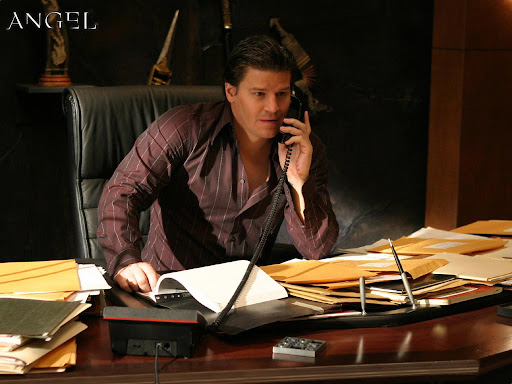
Angel was – uh, still evil, but I guess 150 years later is when he’d be running
his unlicensed PI service that repeatedly butted heads with the actual police
force. Which was, of course, useless in the fight against demons despite
overwhelming evidence of the existence of demonic activity.
 |
| en.bestpicturesof.com. |
Angel the Series
makes up for it with the gray Wolfram and Hart plot arc, where the Fang Gang
tries reforming an evil law firm. And Angel signs away his opportunity to be
human, because it meant fulfilling his scheme and saving the world. Nick? Not
so much.
He has all the time in the world to use his gifts for the
good of the society he’s supposedly trying to repay. And he’s throwing it all
away to feel redeemed, without actually being redeemed.
Dying for your own sins, which is Christian in kind of a self-absorbed
way, is easier and more selfish than the hard work, difficult decisions, and
moral ambiguity that constitutes redemption through good works.
Becoming human would be less moral, Nick. You may feel like
you’d be on the side of good, because your understanding of metaphysics is
stuck in the Middle Ages. But all the people you could have helped will still
be dead. And then you’ll be dead.
 |
| mybeutifulroses.blogspot.com |
But I have to say; the absolute worst is when I have to
listen to Nick frame his desire to be human as the desire to see a sunrise. The
theme narration says it all: ‘emerge from his world of darkness, from his
endless forever knight.’ Yes – Classic Vampire Angst in a nutshell: seasonal
affective disorder.
Louis had that same thing in Interview. I kinda liked that scene, I guess – at least Louis was
getting enthusiastic about new technology. Hah: some of our elders flinched the
first time they saw a sunrise film. I was mostly just excited about the film
itself.
Films were exciting for just being films back in the
Progressive Era. It was just so cool that they could do that with pictures.
Seeing the sunrise itself on film was like looking at old tintypes: ‘Oh yeah. I
forgot about this.’ Commemorating the past, not looking toward the future.
Nick - it’s the early 1990s. Watch a video if you want a
sunrise. You can fast-forward through it, too – and you have color, not like us
poor slobs a few decades before. YouTube is less than two decades away – you
can get all the sunrises you want, all over the world.
Wait a little while longer, and we’ll have Augmented Reality
technology that can simulates the sunrise so it’ll look more real than the real
thing. Constant simulated sunrises that never stop, and all you may need is a
high-bandwidth Internet connection and decent AR glasses. ‘Sun’ = ‘human?’
Wouldn’t that make you superlatively human?
 |
| simple.wikipedia.org |
Why are you pining for what you lost in 1228, when you have
the whole twentieth century at your disposal, and the 21st is right
around the corner?
I know that sunlight is a symbol, and the sun represents
‘humanity’ for Nick. Well, Nick – think of it this way. Our technology will
allow you to see the sun, meaning technology has created a bridge over which
you can rejoin the human race. We’ve advanced to the point where we can all be
‘human’ together. If that’s what you want, and you don’t know how to feel good
about yourself in any other way.
The sunrise is great: if people like the sun, awesome. We
all have our preferences. And Nick, I’m sure you’d start tearing up if you saw
the sunrise again. You know something that made me cry? Seeing a picture of my
planet from space.
 |
| collthings.co.uk |
That Big Blue Marble photo from the Apollo 17 mission? It’s
one of the most published photographs now, and barely even raises an eyebrow.
But I saw it and I couldn’t stop thinking: that’s the earth. That’s us –
everything that’s ever happened in human history – right there. Even the Lunar
Orbiter 1 photo from 1966 was exciting – we saw this little scrap of the Earth,
but it was still Earth.
Now you can watch videos on YouTube that pan out from our
planet through the universe.
Here’s an artist’s rendering of the Earth from the 1400s:
 |
| en.wikipedia.org |
It makes me cry for a different reason.
The amount of scientific and social progress that has
occurred in my lifetime boggles the mind. It’s genuinely humbling to look back,
and think where we were in the 1870s, and where we are now. And I got the
opportunity to be a part of it, to whatever extent I could.
Nick, I don’t know why you’d genuinely give up everything
for the sake of moral symbolism.
I haven’t led a blameless life either, Nick, and I’ve done a
lot that I’m not proud of. But I don’t regret still being here for a moment.
And, in the words of Daria, ‘there’s nothing like seeing the
sunrise, except seeing the sun set in reverse. Get a VCR.
Or better yet, a spacesuit.
Subscribe to:
Posts (Atom)